
Weekend Warrior: Ready for the Weekend?
Weekend Warrior: When Your Weekday and Weekend Activity Levels Don’t Match
You’ve spent most of the week sitting at a desk, travelling in the car, going to meetings or generally fitting movement around everything else you have to do. Then Saturday morning arrives and suddenly the demands on your body look completely different. You might be heading out for 90 minutes of five-a-side, playing a round of golf, taking the bike out for several hours or finally getting around to that garden or DIY job you’ve been putting off.
There’s nothing wrong with making the most of your weekend. In fact, being active at the weekend can be a really valuable part of staying healthy. The interesting question is whether your body is regularly being asked to go from a fairly sedentary five days to a much more physically demanding sixth.
This pattern is sometimes described as being a “weekend warrior”, and during Men’s Health Awareness Month it gives us an interesting question to explore. If Saturday and Sunday are when you have the time to exercise, play sport or tackle physically demanding jobs, how can you help your body stay ready for them during the rest of the week?
Is Being a Weekend Warrior Actually a Bad Thing?
The name makes it sound as though concentrating your exercise into the weekend is something we should be warning you against, but that would miss an important part of the story.
Research has found that people who achieve recommended levels of physical activity over one or two days can still experience important health benefits. Studies have compared people whose moderate-to-vigorous activity is concentrated into one or two days with those who spread similar amounts of activity throughout the week, with encouraging results.
That is good news for anyone whose job, commute, family commitments or general routine makes weekday exercise difficult. The exercise you manage to do at the weekend still counts.
Current UK guidance recommends at least 150 minutes of moderate-intensity activity or 75 minutes of vigorous-intensity activity each week, alongside strengthening activities on at least two days. It also encourages us to reduce long periods spent sitting and make movement part of everyday life. (NHS Guidelines)
So this article isn’t about telling you that your Saturday morning football, Sunday cycle or weekend round of golf is a bad idea. Far from it. It’s about looking at what happens during the days in between.
Monday to Friday: Desk. Saturday: Athlete.
Think about the difference between an average Wednesday and an average Saturday.
During the week, you might get out of bed, drive to work, spend several hours sitting, drive home and sit down again in the evening. Even if you take a lunchtime walk or fit in a gym session, there may still be long stretches of the day when your muscles and joints aren’t being asked to do very much.
We looked at this in more detail in Does Sitting Slow Your Metabolism?, where we explored what happens when large muscle groups spend much of the day relatively inactive. Sitting itself isn’t the enemy, but when it dominates the day, there are fewer opportunities for the body to move, change position and use those muscles.
Now compare that with Saturday. Within a few hours of getting up, you might be sprinting after a football, swinging a golf club dozens of times, climbing hills on a bike, lifting bags of compost or repeatedly bending, reaching and twisting while doing jobs around the house.
The issue isn’t that those movements are inherently dangerous. Our bodies are designed to move, and challenging them is part of staying fit and capable. It’s simply worth recognising that the physical demand has changed considerably.
If most of your movement is saved for the weekend, the answer isn’t necessarily to do less at the weekend. A better question might be: could you do a little more during the week?
Your Body Likes Consistency
One of the themes we return to regularly at Avalon is that movement doesn’t have to happen in one big block to be worthwhile.
A ten-minute walk at lunchtime, getting up from your desk regularly, using the stairs, a short strength session at home or spending a few minutes working on mobility might not feel particularly impressive. But repeated throughout the week, those small bouts of activity mean your body isn’t spending five days largely inactive before suddenly being asked to perform.
Our article on walking for stress relief focused on walking as a simple way to introduce more movement into everyday life. That simplicity is useful here too. You don’t necessarily need another major workout during an already busy working week. Sometimes the more realistic goal is simply to stop movement being something that only happens at the weekend.
Mobility can be approached in much the same way. If sitting at a desk or driving makes up a large part of your week, regularly moving your hips, shoulders and spine through different comfortable ranges can provide some useful variety. We explored this further in Can Yoga Help Improve Spinal Mobility?, including why regular controlled movement can be particularly helpful when everyday life involves spending a lot of time in repetitive positions.
Your Weekend Workout Might Not Look Like a Workout
Of course, not every weekend warrior owns a pair of football boots or a road bike. Sometimes the biggest physical challenge of the week is waiting in the garage.
You decide to spend Saturday sorting the garden, so you spend four hours digging, lifting bags of compost, pushing a wheelbarrow and repeatedly bending down. Or perhaps you’re decorating a room, clearing out the loft, moving furniture, washing the car or finally building the shed that has been sitting in boxes for three months.
We don’t always mentally categorise these jobs as exercise, but our muscles don’t care what we call them. Gardening, decorating and DIY can involve prolonged periods of lifting, carrying, gripping, reaching, kneeling, twisting and working in positions we don’t normally spend much time in. If your usual working week involves very little of that, it shouldn’t be particularly surprising if you notice the difference afterwards.
This doesn’t mean you need a training programme before you’re allowed to paint the spare bedroom. It simply means the same principles that apply to sport can be useful elsewhere too: build into demanding tasks where possible, change position regularly, take breaks and avoid trying to complete several months’ worth of physical jobs in one heroic Saturday afternoon.
A Warm-Up Should Prepare You for What You’re About to Do
If your weekend activity is sport or structured exercise, a sensible warm-up is one of the easiest things to build into your routine. A warm-up doesn’t need to take half an hour and it isn’t simply a matter of bending down, touching your toes twice and declaring yourself ready. The aim is to gradually increase your level of activity and prepare for the movements you’re about to perform.
For football, that might mean gradually progressing from walking and jogging into changes of direction and movements similar to those you’ll use during the game. Before a run, it might involve walking and easy running before settling into your normal pace. If you’re heading into the gym, lighter versions of the movements you plan to perform can help you build towards the working sets.
The principle is straightforward: don’t make the first demanding movement of the day the most demanding movement you’ve done all week.
What About That Sunday-Morning Ache?
If you do considerably more activity than you’re accustomed to, it isn’t unusual to feel it afterwards. Muscles can feel tired, heavy or generally sore after unfamiliar or particularly demanding exercise, and delayed-onset muscle soreness can become noticeable in the day or two following activity.
That is different from assuming that every pain should simply be dismissed because you exercised yesterday. Patterns matter.
If you repeatedly get the same pain every time you play golf, your knee bothers you on every run, your back flares up whenever you spend a day gardening or the same shoulder hurts after every gym session, that is useful information. You may have become accustomed to resting until it settles and then repeating exactly the same cycle the following weekend, but recurrence is a reason to look a little more closely at what is happening.
The same applies when discomfort begins changing how you move. Perhaps you’ve shortened your golf swing, stopped running as far, started avoiding certain exercises or found yourself limping towards the end of a walk. In our article Does Your Hip Pain Make Walking Difficult?, we discussed why recurring discomfort and changes in movement can be worth assessing rather than simply accepting them as part of being active.
The goal isn’t to worry about every ache after exercise. It’s to recognise the difference between occasionally feeling that you’ve had a busy weekend and repeatedly having the same problem interfere with the activities you enjoy.
Strength During the Week Can Support What You Enjoy at the Weekend
This is where our recent Men’s Health discussion around muscle and strength becomes particularly relevant. Strength training isn’t only for people interested in lifting heavier weights. Strong muscles help us run, cycle, lift, carry, climb, change direction and control movement. They are just as relevant to the person carrying paving slabs around the garden as they are to somebody training in a gym.
If the activities you love doing at the weekend place significant demands on your legs, hips, back, shoulders or arms, including some appropriate strengthening work during the week can be a useful part of maintaining your overall physical capacity.
It doesn’t necessarily require hours in the gym. Depending on your experience and goals, bodyweight exercises, resistance bands, weights and other forms of resistance exercise can all be used to challenge the major muscle groups.
The aim isn’t to turn every day into another training day. Rest and recovery are important too. It is about creating a little more balance between a working week in which your body may do relatively little and a weekend in which you expect quite a lot from it.
Don’t Let One Painful Weekend Become a Reason to Stop
One of the least helpful outcomes would be to read an article like this and conclude that strenuous weekend activity should be avoided. For most people, we want exactly the opposite.
If football gets you moving and gives you time with your friends, that’s valuable. If cycling clears your head after a busy week, keep cycling. If you love golf, hiking, running, gardening or spending Sunday working on a project, those activities can be important for physical health, mental wellbeing and simply enjoying life.
The better approach is to help your body stay capable of doing them. That might mean introducing more movement into the working day, building strength, maintaining mobility, warming up properly or gradually increasing the amount and intensity of an activity rather than jumping straight back to where you left off months ago. It can also mean paying attention when the same problem keeps returning.
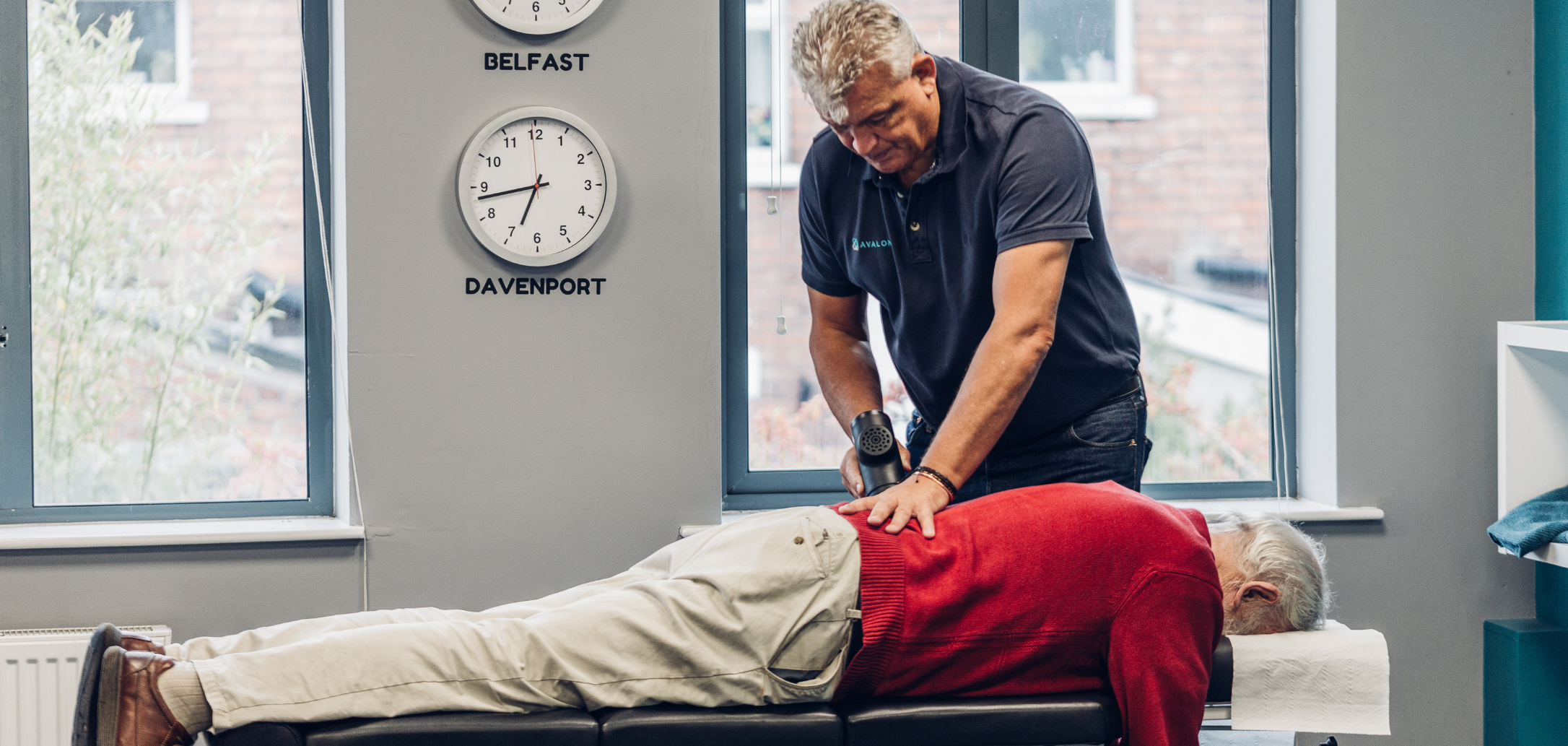
At Avalon Chiropractic in Belfast, we look at movement and function as part of the wider picture when someone is struggling with recurring musculoskeletal pain or restricted movement. If an ache is repeatedly stopping you doing the sport, exercise or activity you enjoy, having it properly assessed may help you understand what is contributing to the problem and what your options are.
Make Your Week Support Your Weekend
Being a weekend warrior doesn’t have to be a criticism. For many busy people, the weekend is simply when they have the freedom to be most active, and getting that activity is far better than doing none at all. But your body doesn’t know that Wednesday is a workday and Saturday is your day for sport. It responds to what you repeatedly ask it to do.
So if you want to keep making the most of your weekends, think about what happens Monday to Friday as well. Break up long periods of sitting. Walk when you can. Use your muscles. Keep moving through different ranges. Build strength appropriate to the activities you enjoy and give yourself time to recover when you’ve worked hard. You don’t need to train seven days a week, and you don’t need to give up the activities you look forward to.
Your weekend shouldn’t be something your body has to survive. Your weekday habits can help prepare you to enjoy it.


Weekend Warrior: Ready for the Weekend?
Weekend Warrior: When Your Weekday and Weekend Activity Levels Don’t Match
You’ve spent most of the week sitting at a desk, travelling in the car, going to meetings or generally fitting movement around everything else you have to do. Then Saturday morning arrives and suddenly the demands on your body look completely different. You might be heading out for 90 minutes of five-a-side, playing a round of golf, taking the bike out for several hours or finally getting around to that garden or DIY job you’ve been putting off.
There’s nothing wrong with making the most of your weekend. In fact, being active at the weekend can be a really valuable part of staying healthy. The interesting question is whether your body is regularly being asked to go from a fairly sedentary five days to a much more physically demanding sixth.
This pattern is sometimes described as being a “weekend warrior”, and during Men’s Health Awareness Month it gives us an interesting question to explore. If Saturday and Sunday are when you have the time to exercise, play sport or tackle physically demanding jobs, how can you help your body stay ready for them during the rest of the week?
Is Being a Weekend Warrior Actually a Bad Thing?
The name makes it sound as though concentrating your exercise into the weekend is something we should be warning you against, but that would miss an important part of the story.
Research has found that people who achieve recommended levels of physical activity over one or two days can still experience important health benefits. Studies have compared people whose moderate-to-vigorous activity is concentrated into one or two days with those who spread similar amounts of activity throughout the week, with encouraging results.
That is good news for anyone whose job, commute, family commitments or general routine makes weekday exercise difficult. The exercise you manage to do at the weekend still counts.
Current UK guidance recommends at least 150 minutes of moderate-intensity activity or 75 minutes of vigorous-intensity activity each week, alongside strengthening activities on at least two days. It also encourages us to reduce long periods spent sitting and make movement part of everyday life. (NHS Guidelines)
So this article isn’t about telling you that your Saturday morning football, Sunday cycle or weekend round of golf is a bad idea. Far from it. It’s about looking at what happens during the days in between.
Monday to Friday: Desk. Saturday: Athlete.
Think about the difference between an average Wednesday and an average Saturday.
During the week, you might get out of bed, drive to work, spend several hours sitting, drive home and sit down again in the evening. Even if you take a lunchtime walk or fit in a gym session, there may still be long stretches of the day when your muscles and joints aren’t being asked to do very much.
We looked at this in more detail in Does Sitting Slow Your Metabolism?, where we explored what happens when large muscle groups spend much of the day relatively inactive. Sitting itself isn’t the enemy, but when it dominates the day, there are fewer opportunities for the body to move, change position and use those muscles.
Now compare that with Saturday. Within a few hours of getting up, you might be sprinting after a football, swinging a golf club dozens of times, climbing hills on a bike, lifting bags of compost or repeatedly bending, reaching and twisting while doing jobs around the house.
The issue isn’t that those movements are inherently dangerous. Our bodies are designed to move, and challenging them is part of staying fit and capable. It’s simply worth recognising that the physical demand has changed considerably.
If most of your movement is saved for the weekend, the answer isn’t necessarily to do less at the weekend. A better question might be: could you do a little more during the week?
Your Body Likes Consistency
One of the themes we return to regularly at Avalon is that movement doesn’t have to happen in one big block to be worthwhile.
A ten-minute walk at lunchtime, getting up from your desk regularly, using the stairs, a short strength session at home or spending a few minutes working on mobility might not feel particularly impressive. But repeated throughout the week, those small bouts of activity mean your body isn’t spending five days largely inactive before suddenly being asked to perform.
Our article on walking for stress relief focused on walking as a simple way to introduce more movement into everyday life. That simplicity is useful here too. You don’t necessarily need another major workout during an already busy working week. Sometimes the more realistic goal is simply to stop movement being something that only happens at the weekend.
Mobility can be approached in much the same way. If sitting at a desk or driving makes up a large part of your week, regularly moving your hips, shoulders and spine through different comfortable ranges can provide some useful variety. We explored this further in Can Yoga Help Improve Spinal Mobility?, including why regular controlled movement can be particularly helpful when everyday life involves spending a lot of time in repetitive positions.
Your Weekend Workout Might Not Look Like a Workout
Of course, not every weekend warrior owns a pair of football boots or a road bike. Sometimes the biggest physical challenge of the week is waiting in the garage.
You decide to spend Saturday sorting the garden, so you spend four hours digging, lifting bags of compost, pushing a wheelbarrow and repeatedly bending down. Or perhaps you’re decorating a room, clearing out the loft, moving furniture, washing the car or finally building the shed that has been sitting in boxes for three months.
We don’t always mentally categorise these jobs as exercise, but our muscles don’t care what we call them. Gardening, decorating and DIY can involve prolonged periods of lifting, carrying, gripping, reaching, kneeling, twisting and working in positions we don’t normally spend much time in. If your usual working week involves very little of that, it shouldn’t be particularly surprising if you notice the difference afterwards.
This doesn’t mean you need a training programme before you’re allowed to paint the spare bedroom. It simply means the same principles that apply to sport can be useful elsewhere too: build into demanding tasks where possible, change position regularly, take breaks and avoid trying to complete several months’ worth of physical jobs in one heroic Saturday afternoon.
A Warm-Up Should Prepare You for What You’re About to Do
If your weekend activity is sport or structured exercise, a sensible warm-up is one of the easiest things to build into your routine. A warm-up doesn’t need to take half an hour and it isn’t simply a matter of bending down, touching your toes twice and declaring yourself ready. The aim is to gradually increase your level of activity and prepare for the movements you’re about to perform.
For football, that might mean gradually progressing from walking and jogging into changes of direction and movements similar to those you’ll use during the game. Before a run, it might involve walking and easy running before settling into your normal pace. If you’re heading into the gym, lighter versions of the movements you plan to perform can help you build towards the working sets.
The principle is straightforward: don’t make the first demanding movement of the day the most demanding movement you’ve done all week.
What About That Sunday-Morning Ache?
If you do considerably more activity than you’re accustomed to, it isn’t unusual to feel it afterwards. Muscles can feel tired, heavy or generally sore after unfamiliar or particularly demanding exercise, and delayed-onset muscle soreness can become noticeable in the day or two following activity.
That is different from assuming that every pain should simply be dismissed because you exercised yesterday. Patterns matter.
If you repeatedly get the same pain every time you play golf, your knee bothers you on every run, your back flares up whenever you spend a day gardening or the same shoulder hurts after every gym session, that is useful information. You may have become accustomed to resting until it settles and then repeating exactly the same cycle the following weekend, but recurrence is a reason to look a little more closely at what is happening.
The same applies when discomfort begins changing how you move. Perhaps you’ve shortened your golf swing, stopped running as far, started avoiding certain exercises or found yourself limping towards the end of a walk. In our article Does Your Hip Pain Make Walking Difficult?, we discussed why recurring discomfort and changes in movement can be worth assessing rather than simply accepting them as part of being active.
The goal isn’t to worry about every ache after exercise. It’s to recognise the difference between occasionally feeling that you’ve had a busy weekend and repeatedly having the same problem interfere with the activities you enjoy.
Strength During the Week Can Support What You Enjoy at the Weekend
This is where our recent Men’s Health discussion around muscle and strength becomes particularly relevant. Strength training isn’t only for people interested in lifting heavier weights. Strong muscles help us run, cycle, lift, carry, climb, change direction and control movement. They are just as relevant to the person carrying paving slabs around the garden as they are to somebody training in a gym.
If the activities you love doing at the weekend place significant demands on your legs, hips, back, shoulders or arms, including some appropriate strengthening work during the week can be a useful part of maintaining your overall physical capacity.
It doesn’t necessarily require hours in the gym. Depending on your experience and goals, bodyweight exercises, resistance bands, weights and other forms of resistance exercise can all be used to challenge the major muscle groups.
The aim isn’t to turn every day into another training day. Rest and recovery are important too. It is about creating a little more balance between a working week in which your body may do relatively little and a weekend in which you expect quite a lot from it.
Don’t Let One Painful Weekend Become a Reason to Stop
One of the least helpful outcomes would be to read an article like this and conclude that strenuous weekend activity should be avoided. For most people, we want exactly the opposite.
If football gets you moving and gives you time with your friends, that’s valuable. If cycling clears your head after a busy week, keep cycling. If you love golf, hiking, running, gardening or spending Sunday working on a project, those activities can be important for physical health, mental wellbeing and simply enjoying life.
The better approach is to help your body stay capable of doing them. That might mean introducing more movement into the working day, building strength, maintaining mobility, warming up properly or gradually increasing the amount and intensity of an activity rather than jumping straight back to where you left off months ago. It can also mean paying attention when the same problem keeps returning.
At Avalon Chiropractic in Belfast, we look at movement and function as part of the wider picture when someone is struggling with recurring musculoskeletal pain or restricted movement. If an ache is repeatedly stopping you doing the sport, exercise or activity you enjoy, having it properly assessed may help you understand what is contributing to the problem and what your options are.
Make Your Week Support Your Weekend
Being a weekend warrior doesn’t have to be a criticism. For many busy people, the weekend is simply when they have the freedom to be most active, and getting that activity is far better than doing none at all. But your body doesn’t know that Wednesday is a workday and Saturday is your day for sport. It responds to what you repeatedly ask it to do.
So if you want to keep making the most of your weekends, think about what happens Monday to Friday as well. Break up long periods of sitting. Walk when you can. Use your muscles. Keep moving through different ranges. Build strength appropriate to the activities you enjoy and give yourself time to recover when you’ve worked hard. You don’t need to train seven days a week, and you don’t need to give up the activities you look forward to.
Your weekend shouldn’t be something your body has to survive. Your weekday habits can help prepare you to enjoy it.