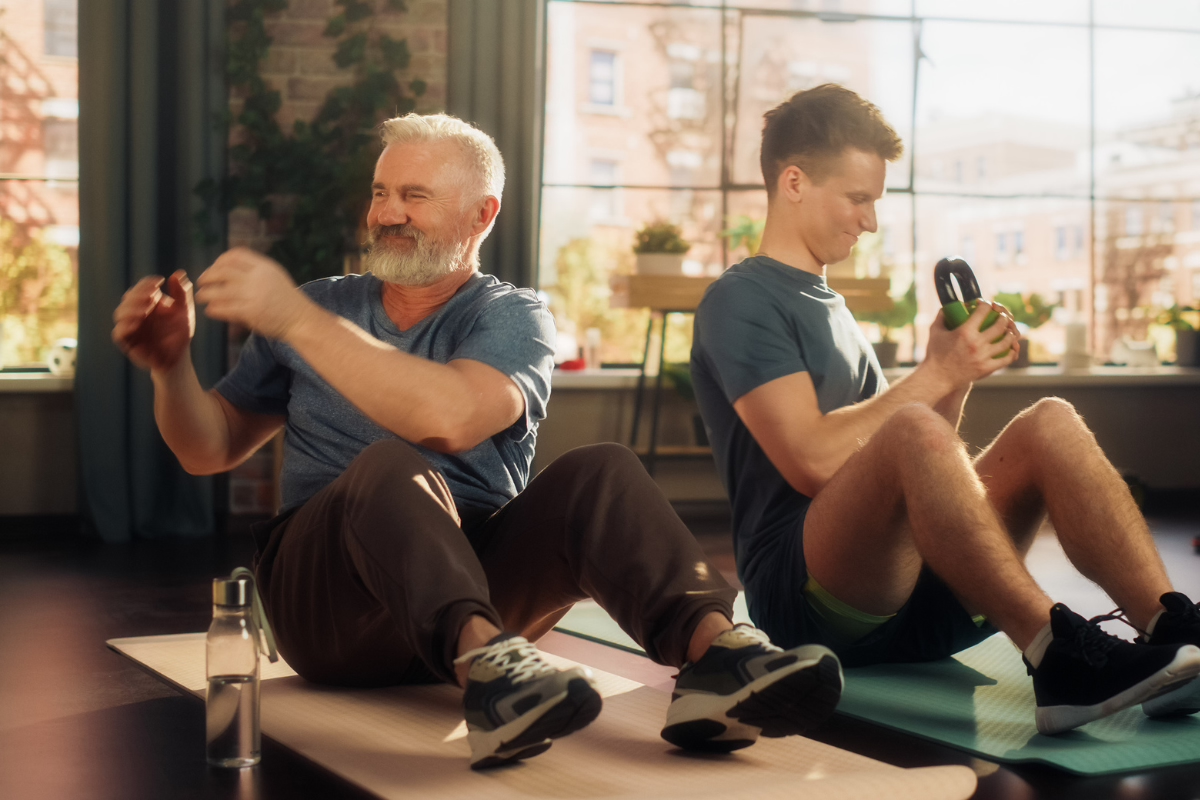
Men Over 40: What Happens to Muscle, Strength and Mobility as We Age?
Forty isn’t a switch that suddenly changes your body overnight. You don’t wake up on your 40th birthday with weaker muscles, tighter joints and an irresistible urge to make a noise every time you get out of a chair.
But somewhere through midlife, many of us do start noticing little differences. Recovering from a hard workout might take a little longer. An activity you haven’t done for six months can make itself known the following morning. Perhaps you’ve lost some of the flexibility you once took for granted, or you’ve realised that being active isn’t necessarily the same thing as being strong.
During Men’s Health Awareness Month, we’ve been looking at some of the aspects of men’s health that don’t always get much attention. Last week, we explored the everyday aches we gradually learn to live with. This week, we’re looking further ahead.
What happens to our muscles, strength and mobility as we get older — and, more importantly, what can we do to help maintain them?
Your Body Doesn’t Suddenly Change at 40
Let’s get one thing out of the way first: 40 isn’t an expiry date. Ageing is a gradual process, and there is enormous variation between individuals. How active you are, the type of activity you do, your general health, nutrition, sleep and other lifestyle factors can all influence how your body feels and functions as you get older.
However, age-related changes to skeletal muscle are real. Over time, we can gradually lose muscle mass, strength and physical performance. More significant age-related loss of muscle mass and function is known as sarcopenia, something that becomes particularly important in later life.
That doesn’t mean declining strength is something we simply have to accept. Resistance exercise is one of the key ways we can continue challenging our muscles as we age, and UK physical activity guidance recommends that adults include activities that strengthen the major muscle groups on at least two days each week.
And that matters for far more than how much weight you can lift at the gym.
Why Muscle Matters Even If You Don’t Care About Looking Muscular
When we hear the words “building muscle”, it’s easy to picture barbells, protein shakes and somebody trying to make their arms bigger. But muscle is much more useful than that.
You use muscular strength to carry the shopping into the house, lift a suitcase into the boot of the car, climb stairs, get out of a low chair, work in the garden, pick up a child, do DIY and get yourself back up from the floor.
It supports sport too, whether your thing is golf, cycling, running, football, hiking or simply being able to go for a long walk without feeling exhausted afterwards. That’s why maintaining strength as we get older isn’t really about trying to look younger.
It’s about maintaining capacity. What would you like your body still to be able to do at 50, 60 or 70? That is a much more useful question.
“But I Walk All the Time. Isn’t That Enough?”
Walking is one of the best habits you can build into everyday life. It’s accessible, requires no special equipment and can contribute to cardiovascular fitness as well as getting us away from our desks, screens and cars. We’ve previously looked at some of its wider benefits in our article on walking for stress relief.
So we’re certainly not going to tell you to stop walking. But walking and strength training don’t do exactly the same job.
UK guidelines recommend both aerobic activity and activities that develop or maintain muscle strength. Adults should aim for at least 150 minutes of moderate-intensity activity each week, or 75 minutes of vigorous activity, alongside muscle-strengthening activities on at least two days.
That doesn’t mean you need a gym membership. Strengthening activity can include lifting weights, using resistance bands, bodyweight exercises such as squats and press-ups, yoga, carrying heavy loads and some forms of heavy gardening. The important thing is that your muscles are being asked to work harder than they normally would.
Strength Training Doesn’t Have to Mean Heavy Lifting
This is where some people switch off because they assume strength training means walking into a weights room and trying to lift something enormous. It doesn’t. Resistance simply means your muscles are working against a load. That load could be a dumbbell or barbell, but it could also be a resistance band or your own bodyweight.
The right starting point depends on your current fitness, experience and health. If you haven’t exercised for some time, suddenly copying the workout you did in your twenties probably isn’t the wisest approach. Start at a level that’s appropriate for where you are now and gradually increase the challenge as your strength improves.
Consistency is far more useful than doing one heroic workout and spending the next five days regretting it. And if you have an existing medical condition, haven’t exercised for a long time or have concerns about starting a new exercise programme, it’s sensible to speak to an appropriate healthcare professional first.
Don’t Forget About Mobility
Strength is only part of the picture, you also want to be able to move. Mobility isn’t about whether you can perform the splits or touch your toes with perfectly straight legs. It’s about having enough comfortable movement to do the things your everyday life asks of you.
Can you reach overhead comfortably? Turn to look behind you? Bend down? Get onto the floor and back up? Rotate through your upper body? Move your hips comfortably enough to walk, climb stairs and exercise?
Sometimes we don’t notice a gradual loss of movement because we become very good at compensating for it. We find another way to put our shoes on. We turn our whole body instead of our neck. We stop sitting on the floor. We avoid a particular exercise because it feels awkward.
That is why regular movement matters. In Can Yoga Help Improve Spinal Mobility?, we looked at how controlled movement through different positions can help develop mobility, balance and movement control. You don’t have to take up yoga, but the principle is useful: if we want to maintain our ability to move through different ranges, we need to keep using them.
An Hour in the Gym Doesn’t Tell Us What the Rest of Your Day Looks Like
Here’s another common scenario. You exercise three times a week, so you consider yourself pretty active. But you also drive to work, spend eight hours at a desk, drive home and spend much of the evening sitting down. Exercise absolutely counts, but so does everything happening between those workouts.
UK guidance recommends breaking up long periods of inactivity as well as completing structured exercise. That’s something we’ve explored before in Does Sitting Slow Your Metabolism?, where we looked at what happens when large muscle groups spend much of the day doing very little work.
Our Summer Health Check raised a useful question too: even if you exercise, what are you doing during the other 23 hours of the day? Standing up regularly, walking while you’re on the phone, taking the stairs, going for a lunchtime walk or doing jobs around the house might not feel like “exercise”, but they all help make movement a normal part of your day.
Recovery Might Need a Little More Respect
There’s another change many people notice as they move through their forties: they don’t always bounce back from a hard session quite as quickly as they once did. That doesn’t mean you need to exercise gently for the rest of your life. It does mean that recovery deserves a place in the conversation.
Training hard every day isn’t necessarily better than training intelligently. Giving muscles time to recover, getting enough sleep, eating well and gradually progressing your exercise can help you build consistency rather than repeatedly pushing too hard, becoming sore or injured, stopping for several weeks and starting all over again.
You don’t need to prove anything with every workout. The goal is to still be exercising next month, next year and ideally for decades to come.
Don’t Train Like You’re Still 20 — Train So You Can Still Do Things at 70
This might be the most important shift in mindset. Exercise in your twenties can easily become about performance, appearance or pushing yourself as hard as possible. Those things don’t necessarily have to disappear as you get older. If you love competing, lifting heavy weights, running races or chasing personal bests, there’s no reason your 40th birthday should suddenly change that. But there’s another goal worth adding.
Longevity.
Can the things you’re doing now help you maintain the strength to climb stairs easily later in life? The mobility to get down onto the floor? The confidence to carry your own bags? The fitness to explore somewhere on holiday? The strength and balance to keep enjoying the hobbies you love?
The workout you do today isn’t only for the body you have today. You’re also investing in the body you’re going to rely on years from now.
What If Pain Is Stopping You Exercising?
This is where things can become frustrating. You know staying active is important, but your back hurts when you run. Your hip bothers you on longer walks. Your shoulder doesn’t like a particular gym movement, or stiffness makes certain exercises difficult. The temptation can be to stop.
Sometimes temporarily modifying an activity is sensible. But if pain or restricted movement repeatedly prevents you from exercising, it’s worth understanding what is happening rather than indefinitely removing more and more activities from your life. For example, we’ve previously looked at what to consider when hip pain starts making walking difficult. The principle applies more broadly too: if discomfort is beginning to dictate how active you can be, having the problem appropriately assessed can help you understand your options.
The goal isn’t necessarily to get you back to one particular exercise at all costs, it’s to help you keep moving.
Think About What You’re Training For
Maybe you’re not training for anything, no marathon, no cycling event, no bodybuilding competition. But perhaps you’re training to still be able to play golf in your seventies.
You’re training to carry your own suitcase through the airport. You’re training to keep up with your children now and perhaps your grandchildren one day. You’re training to get off the floor without needing something to pull yourself up with. You’re training to keep gardening, travelling, walking, cycling, working, playing sport or doing whatever makes your life feel like yours. That is why strength and mobility deserve a place in the men’s health conversation.
Looking after yourself isn’t indulgent, and it doesn’t have to start because something has gone wrong. As we discussed in Why Self-Care Is About Self-Respect, Not Indulgence, the things we do for our health today can help support the life we want to continue living in the future.
What Do You Want Your Body to Still Be Able to Do?
Instead of thinking about getting older purely in terms of what you might lose, think about what you’d like to keep. Your strength, your movement, your independence, your hobbies and your confidence in what your body can do.
You don’t need to completely transform your lifestyle at 40, and you certainly don’t need to start behaving as though you’re old. Keep walking. Keep moving. Challenge your muscles. Maintain the movements you want to keep. Give recovery the attention it deserves and, if pain or restriction is stopping you from being active, don’t simply remove another activity from your life without asking why.
At Avalon Chiropractic in Belfast, we focus on helping people maintain movement and function at every stage of life. You can read more about why we focus on long-term spinal health or contact the clinic if pain or restricted movement is getting in the way of staying active.
Because the question isn’t simply how old are you? It’s what do you want your body to still be capable of in 10, 20 or 30 years?
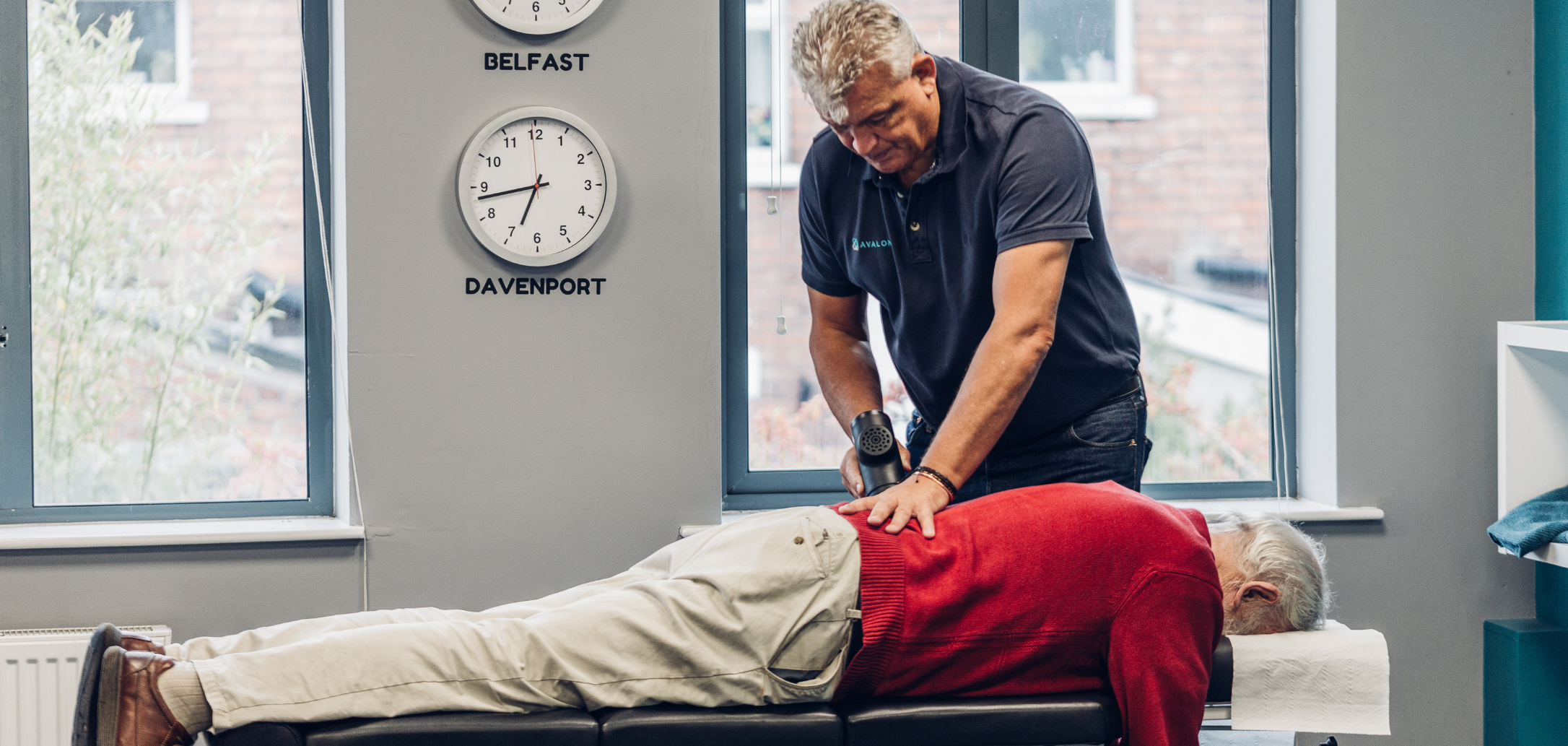


Men Over 40: What Happens to Muscle, Strength and Mobility as We Age?
Forty isn’t a switch that suddenly changes your body overnight. You don’t wake up on your 40th birthday with weaker muscles, tighter joints and an irresistible urge to make a noise every time you get out of a chair.
But somewhere through midlife, many of us do start noticing little differences. Recovering from a hard workout might take a little longer. An activity you haven’t done for six months can make itself known the following morning. Perhaps you’ve lost some of the flexibility you once took for granted, or you’ve realised that being active isn’t necessarily the same thing as being strong.
During Men’s Health Awareness Month, we’ve been looking at some of the aspects of men’s health that don’t always get much attention. Last week, we explored the everyday aches we gradually learn to live with. This week, we’re looking further ahead.
What happens to our muscles, strength and mobility as we get older — and, more importantly, what can we do to help maintain them?
Your Body Doesn’t Suddenly Change at 40
Let’s get one thing out of the way first: 40 isn’t an expiry date. Ageing is a gradual process, and there is enormous variation between individuals. How active you are, the type of activity you do, your general health, nutrition, sleep and other lifestyle factors can all influence how your body feels and functions as you get older.
However, age-related changes to skeletal muscle are real. Over time, we can gradually lose muscle mass, strength and physical performance. More significant age-related loss of muscle mass and function is known as sarcopenia, something that becomes particularly important in later life.
That doesn’t mean declining strength is something we simply have to accept. Resistance exercise is one of the key ways we can continue challenging our muscles as we age, and UK physical activity guidance recommends that adults include activities that strengthen the major muscle groups on at least two days each week.
And that matters for far more than how much weight you can lift at the gym.
Why Muscle Matters Even If You Don’t Care About Looking Muscular
When we hear the words “building muscle”, it’s easy to picture barbells, protein shakes and somebody trying to make their arms bigger. But muscle is much more useful than that.
You use muscular strength to carry the shopping into the house, lift a suitcase into the boot of the car, climb stairs, get out of a low chair, work in the garden, pick up a child, do DIY and get yourself back up from the floor.
It supports sport too, whether your thing is golf, cycling, running, football, hiking or simply being able to go for a long walk without feeling exhausted afterwards. That’s why maintaining strength as we get older isn’t really about trying to look younger.
It’s about maintaining capacity. What would you like your body still to be able to do at 50, 60 or 70? That is a much more useful question.
“But I Walk All the Time. Isn’t That Enough?”
Walking is one of the best habits you can build into everyday life. It’s accessible, requires no special equipment and can contribute to cardiovascular fitness as well as getting us away from our desks, screens and cars. We’ve previously looked at some of its wider benefits in our article on walking for stress relief.
So we’re certainly not going to tell you to stop walking. But walking and strength training don’t do exactly the same job.
UK guidelines recommend both aerobic activity and activities that develop or maintain muscle strength. Adults should aim for at least 150 minutes of moderate-intensity activity each week, or 75 minutes of vigorous activity, alongside muscle-strengthening activities on at least two days.
That doesn’t mean you need a gym membership. Strengthening activity can include lifting weights, using resistance bands, bodyweight exercises such as squats and press-ups, yoga, carrying heavy loads and some forms of heavy gardening. The important thing is that your muscles are being asked to work harder than they normally would.
Strength Training Doesn’t Have to Mean Heavy Lifting
This is where some people switch off because they assume strength training means walking into a weights room and trying to lift something enormous. It doesn’t. Resistance simply means your muscles are working against a load. That load could be a dumbbell or barbell, but it could also be a resistance band or your own bodyweight.
The right starting point depends on your current fitness, experience and health. If you haven’t exercised for some time, suddenly copying the workout you did in your twenties probably isn’t the wisest approach. Start at a level that’s appropriate for where you are now and gradually increase the challenge as your strength improves.
Consistency is far more useful than doing one heroic workout and spending the next five days regretting it. And if you have an existing medical condition, haven’t exercised for a long time or have concerns about starting a new exercise programme, it’s sensible to speak to an appropriate healthcare professional first.
Don’t Forget About Mobility
Strength is only part of the picture, you also want to be able to move. Mobility isn’t about whether you can perform the splits or touch your toes with perfectly straight legs. It’s about having enough comfortable movement to do the things your everyday life asks of you.
Can you reach overhead comfortably? Turn to look behind you? Bend down? Get onto the floor and back up? Rotate through your upper body? Move your hips comfortably enough to walk, climb stairs and exercise?
Sometimes we don’t notice a gradual loss of movement because we become very good at compensating for it. We find another way to put our shoes on. We turn our whole body instead of our neck. We stop sitting on the floor. We avoid a particular exercise because it feels awkward.
That is why regular movement matters. In Can Yoga Help Improve Spinal Mobility?, we looked at how controlled movement through different positions can help develop mobility, balance and movement control. You don’t have to take up yoga, but the principle is useful: if we want to maintain our ability to move through different ranges, we need to keep using them.
An Hour in the Gym Doesn’t Tell Us What the Rest of Your Day Looks Like
Here’s another common scenario. You exercise three times a week, so you consider yourself pretty active. But you also drive to work, spend eight hours at a desk, drive home and spend much of the evening sitting down. Exercise absolutely counts, but so does everything happening between those workouts.
UK guidance recommends breaking up long periods of inactivity as well as completing structured exercise. That’s something we’ve explored before in Does Sitting Slow Your Metabolism?, where we looked at what happens when large muscle groups spend much of the day doing very little work.
Our Summer Health Check raised a useful question too: even if you exercise, what are you doing during the other 23 hours of the day? Standing up regularly, walking while you’re on the phone, taking the stairs, going for a lunchtime walk or doing jobs around the house might not feel like “exercise”, but they all help make movement a normal part of your day.
Recovery Might Need a Little More Respect
There’s another change many people notice as they move through their forties: they don’t always bounce back from a hard session quite as quickly as they once did. That doesn’t mean you need to exercise gently for the rest of your life. It does mean that recovery deserves a place in the conversation.
Training hard every day isn’t necessarily better than training intelligently. Giving muscles time to recover, getting enough sleep, eating well and gradually progressing your exercise can help you build consistency rather than repeatedly pushing too hard, becoming sore or injured, stopping for several weeks and starting all over again.
You don’t need to prove anything with every workout. The goal is to still be exercising next month, next year and ideally for decades to come.
Don’t Train Like You’re Still 20 — Train So You Can Still Do Things at 70
This might be the most important shift in mindset. Exercise in your twenties can easily become about performance, appearance or pushing yourself as hard as possible. Those things don’t necessarily have to disappear as you get older. If you love competing, lifting heavy weights, running races or chasing personal bests, there’s no reason your 40th birthday should suddenly change that. But there’s another goal worth adding.
Longevity.
Can the things you’re doing now help you maintain the strength to climb stairs easily later in life? The mobility to get down onto the floor? The confidence to carry your own bags? The fitness to explore somewhere on holiday? The strength and balance to keep enjoying the hobbies you love?
The workout you do today isn’t only for the body you have today. You’re also investing in the body you’re going to rely on years from now.
What If Pain Is Stopping You Exercising?
This is where things can become frustrating. You know staying active is important, but your back hurts when you run. Your hip bothers you on longer walks. Your shoulder doesn’t like a particular gym movement, or stiffness makes certain exercises difficult. The temptation can be to stop.
Sometimes temporarily modifying an activity is sensible. But if pain or restricted movement repeatedly prevents you from exercising, it’s worth understanding what is happening rather than indefinitely removing more and more activities from your life. For example, we’ve previously looked at what to consider when hip pain starts making walking difficult. The principle applies more broadly too: if discomfort is beginning to dictate how active you can be, having the problem appropriately assessed can help you understand your options.
The goal isn’t necessarily to get you back to one particular exercise at all costs, it’s to help you keep moving.
Think About What You’re Training For
Maybe you’re not training for anything, no marathon, no cycling event, no bodybuilding competition. But perhaps you’re training to still be able to play golf in your seventies.
You’re training to carry your own suitcase through the airport. You’re training to keep up with your children now and perhaps your grandchildren one day. You’re training to get off the floor without needing something to pull yourself up with. You’re training to keep gardening, travelling, walking, cycling, working, playing sport or doing whatever makes your life feel like yours. That is why strength and mobility deserve a place in the men’s health conversation.
Looking after yourself isn’t indulgent, and it doesn’t have to start because something has gone wrong. As we discussed in Why Self-Care Is About Self-Respect, Not Indulgence, the things we do for our health today can help support the life we want to continue living in the future.
What Do You Want Your Body to Still Be Able to Do?
Instead of thinking about getting older purely in terms of what you might lose, think about what you’d like to keep. Your strength, your movement, your independence, your hobbies and your confidence in what your body can do.
You don’t need to completely transform your lifestyle at 40, and you certainly don’t need to start behaving as though you’re old. Keep walking. Keep moving. Challenge your muscles. Maintain the movements you want to keep. Give recovery the attention it deserves and, if pain or restriction is stopping you from being active, don’t simply remove another activity from your life without asking why.
At Avalon Chiropractic in Belfast, we focus on helping people maintain movement and function at every stage of life. You can read more about why we focus on long-term spinal health or contact the clinic if pain or restricted movement is getting in the way of staying active.
Because the question isn’t simply how old are you? It’s what do you want your body to still be capable of in 10, 20 or 30 years?